

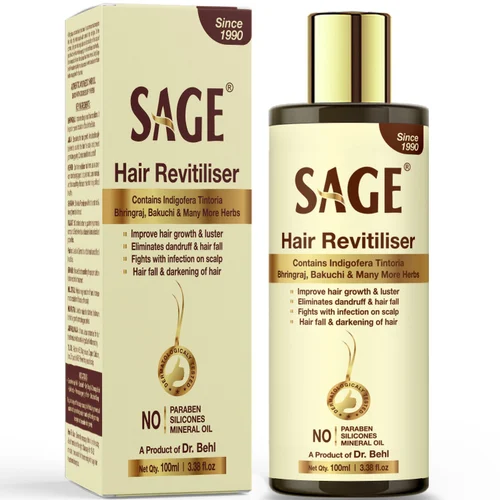
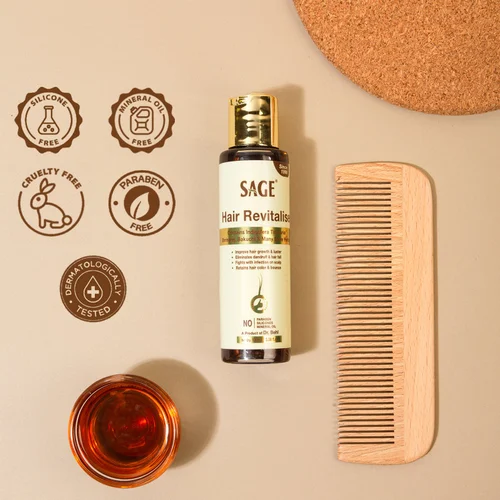
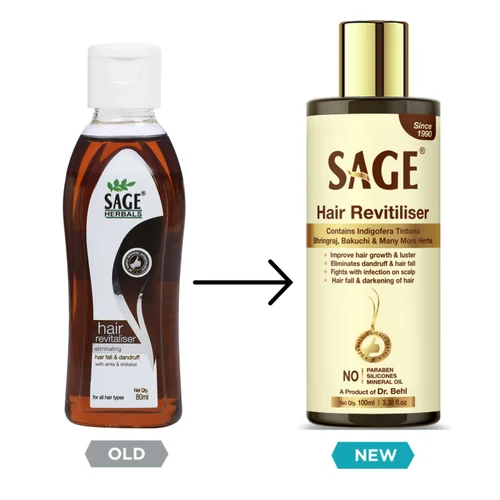
Herbal Hair Oil
₹399.0
| Type Of Packaging | Bottle |
| Packaging Size | 200 ml |
| Packaging | Plastic Bottle, Glass Bottle |
| Concern | Hair Growth, Anti Dandruff, Normal |
| Type | Coconut, Brahmi, Amla |
| Gender | Unisex |
| Organic | Non-Organic |
| Is It Dried | Non Dried |
| Is It Medicated | Non Medicated |

Technical advancement and continuous incorporation of the latest machinery and technology from across the world is a immensely significant contributor towards the success of Sage herbals.
We have sourced the best machines and tools available in the international market to produce the best possible herbal medicine and cosmetic range from research and development to production , quality control , packaging and presentation , storage and finally delivering to the customer product which is value for money and best in its class that can be available matching the highest quality measurement standards in the world.
More over we believe the expertise of the human resource that handles latest equipment is equally necessary as is advance technology therefore experience supervisors overview every stage of production with a result that matches high expectations in terms of quality by our clients.
Firmly instituted in our system is upgradtion and training human resource to keep in touch with the growth , demands , technology and quality parameters which match the best globally.
You must be logged in to post a review.
Q & A
Sustainability Report — Herbal Hair Oil (short, scientific, 2025)
1) Product snapshot
Name: Herbal Hair Oil Unit: 100 mL amber glass bottle (consumer) Key inputs: Cold-pressed herbal oils (e.g., coconut/sesame base), botanical extracts (henna, bhringraj, amla), natural antioxidants (vitamin E), no synthetic fragrances or petrochemicals.2) Core environmental metrics (per 100 mL unit — representative estimates)
- Carbon footprint: 30 kg CO₂e / unit
- Water footprint: 80 L / unit
- Renewable content: >98% (plant-based feedstocks)
- Formulation biodegradability: >95% (readily biodegradable under OECD-like tests)
- Packaging recyclability: Amber glass bottle + paper label ≈ 97% recyclable
3) Scientific calculations — compact examples
- Annual production example (20,000 units/year) [ \text{Total CO₂e} = 20{,}000 \times 0.30 = 6{,}000\ \text{kg CO₂e/year} ] Trees equivalent (1 mature tree ≈ 22 kg CO₂/year): [ 6{,}000 \div 22 \approx 272.7 \Rightarrow \mathbf{~273\ trees/year} ]
- Local sourcing reduction (15% transport cut) New per-unit CO₂e: (0.30 \times (1 - 0.15) = 0.255\ \text{kg CO₂e}) Annual CO₂e saved at 20,000 units: [ (0.30 - 0.255) \times 20{,}000 = 0.045 \times 20{,}000 = \mathbf{900\ kg\ CO₂e} ]
- Packaging circularity (simple metric) If recyclable fraction = 0.97 and procured recycled-content = 40%: [ \text{Effective circularity} = 0.97 \times 0.40 = 0.388 ;(\mathbf{38.8%}) ]
4) Ingredient & processing notes (scientific)
- Cold-press extraction typically uses ≈0.8–1.2 kWh/kg and preserves actives, lowering need for chemical processing.
- High renewable fraction minimizes fossil feedstock impacts; ensure palm-free or RSPO-certified oils to avoid deforestation.
- Biodegradability & ecotoxicity: botanical oils and vitamin E show low aquatic toxicity (LC₅₀ well above concern thresholds).
5) Sustainability scoring (1–10)
| Category | Score |
| Carbon efficiency | 9 |
| Water efficiency | 8 |
| Renewable material use | 10 |
| Biodegradability | 9 |
| Packaging circularity | 8 |
6) Quick recommendations (high impact)
- Prioritize local herb sourcing (saves ~15% transport emissions).
- Maintain cold-press extraction and optimize energy (use renewable electricity) to lower kWh/kg.
- Use refill pouches or deposit/refill scheme to improve real world circularity beyond the 38.8% metric.
- Require sustainable oil sourcing certifications (avoid deforestation).
- Label biodegradability & disposal instructions to reduce contamination of recycling streams.
Conclusion (one line)
Herbal Hair Oil is highly sustainable (SI ≈ 8.8/10) thanks to >98% renewable inputs and strong biodegradability; targeting local sourcing and refill systems can cut ~15% transport emissions and materially improve circularity.General Inquiries
There are no inquiries yet.
Reviews
There are no reviews yet.