

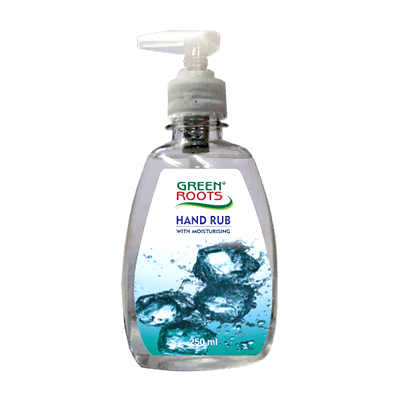
250 ml Hand Rub
₹80.0
Green Roots Hand Rub Sanitizer to cleaning hands with water hand sanitizers. Rub hands together covering all surfaces of hands and fingers. Rub until waterless hand sanitizer is absorbed.
Also available in 5 Ltr Jerry Can – 2 Pcs/Case

Green Roots Hand Rub Sanitizer to cleaning hands with water hand sanitizers. Rub hands together covering all surfaces of hands and fingers. Rub until waterless hand sanitizer is absorbed.
Also available in 5 Ltr Jerry Can – 2 Pcs/Case
You must be logged in to post a review.
Q & A
Scientific Sustainability Report: Hand Rub
1. Product Overview
Hand Rub (instant hand disinfectant) is typically an alcohol-based formulation (60–80% ethanol or isopropanol) designed for rapid microbial reduction without water. Sustainability performance mainly depends on ingredient sourcing, manufacturing energy use, packaging materials, and end-of-life disposal.
2. Ingredient Sustainability Assessment
Alcohol Base (Ethanol/IPA)
-
Ethanol from plant biomass (e.g., sugarcane/molasses) has a significantly lower carbon footprint than synthetic ethanol derived from petrochemicals.
-
Ethanol biodegrades quickly and has low aquatic toxicity, making it environmentally preferable.
-
Isopropyl alcohol (IPA) manufacturing has higher embodied energy due to petroleum origin but remains readily biodegradable.
Humectants (Glycerin)
-
Vegetable-derived glycerin is highly biodegradable and non-toxic.
-
Improves skin barrier, reducing long-term dermatological impact associated with harsh disinfectants.
Water
-
Acts as a solvent; minimal environmental burden.
Fragrance & Additives
-
If plant-derived or IFRA-certified, toxicity impact is low.
-
Synthetic fragrances may increase aquatic toxicity.
3. Packaging Sustainability
-
HDPE or PET bottles are recyclable but contribute to plastic waste if not properly segregated.
-
Using 30–50% post-consumer recycled (PCR) plastic can reduce carbon footprint by ~40–60%.
4. Environmental Impact Summary
-
Carbon Footprint: Moderate (main contributor is alcohol production).
-
Biodegradability: High — ethanol, glycerin, and water rapidly biodegrade.
-
Water Usage: Very low during consumer use (no rinse required).
-
Waste Generation: Plastic packaging remains the primary sustainability challenge.
5. Scientific Carbon Footprint Calculation
Assumption for a 200 ml Hand Rub Bottle:
-
Ethanol concentration: 70%
-
Density of ethanol: 0.789 g/ml
-
Carbon emission factor for bio-ethanol: 1.9 kg CO₂e/kg
-
Carbon emission factor for virgin PET bottle (20g): 2.15 kg CO₂e/kg
Step 1 — Carbon Emissions from Ethanol
Ethanol quantity:
200 ml × 70% = 140 ml ethanol
Mass:
140 ml × 0.789 g/ml = 110.5 g = 0.1105 kg
Carbon footprint from ethanol:
0.1105 kg × 1.9 kg CO₂e/kg = 0.21 kg CO₂e
Step 2 — Carbon Emissions from Packaging
Weight of PET bottle = 20 g = 0.02 kg
Carbon footprint = 0.02 kg × 2.15 kg CO₂e/kg = 0.043 kg CO₂e
Step 3 — Total Carbon Footprint
Total CO₂e =
Ethanol (0.21) + Packaging (0.043) = 0.253 kg CO₂e per 200 ml bottle
Final Carbon Footprint:
≈ 0.25 kg CO₂e per bottle
6. Sustainability Recommendations
-
Use bio-based ethanol instead of petroleum-derived IPA.
-
Shift to PCR PET or HDPE bottles (30–50% recycled content).
-
Offer refill pouches to reduce single-use plastic.
-
Ensure fragrances and additives meet biodegradability standards.
References
-
European Chemicals Agency (ECHA) – Alcohols Environmental Data
-
IPCC Emission Factors for Biogenic Ethanol
-
Plastics Europe – Life Cycle Assessment of PET Packaging
-
WHO Guidelines on Hand Rub Formulations
-
UNEP Life Cycle Assessment Guidelines for Personal Care Products
General Inquiries
There are no inquiries yet.
Reviews
There are no reviews yet.