

Happa Ragi Carrot Beetroot Cereal for Babies | Only 3 Ingredients | No Sugar, Oil, Milk Powder, Flavours or Colours |
₹299.0
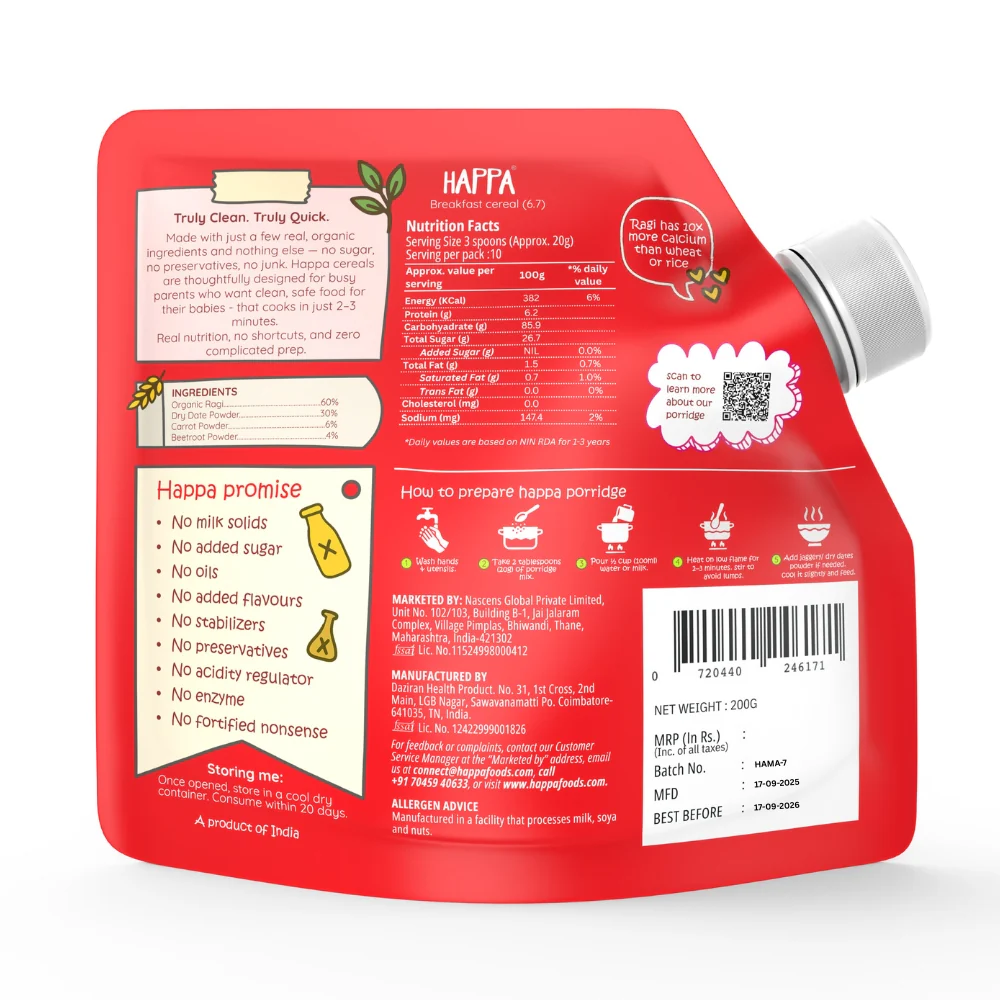
- Made with Only 3 Ingredients : A clean, honest porridge mix made from just three natural ingredients Ragi, Carrot and Beetrrot — no sugar, no oil, no milk powder, no artificial flavours or colours.

- Made with Only 3 Ingredients : A clean, honest porridge mix made from just three natural ingredients Ragi, Carrot and Beetrrot — no sugar, no oil, no milk powder, no artificial flavours or colours.
- Wholesome Traditional Ragi Recipe : Crafted using time-tested recipes from Indian kitchens. Ragi is rich in calcium, iron, and essential nutrients that support healthy growth and immunity.
- Cooks in Just 3 Minutes : Quick and easy to prepare — ideal for busy parents. Just add water, cook for 3 minutes, and serve a warm, nutritious meal your baby will love.
- No Added Sugar, Preservatives or Additives : Made without any sugar, oil, milk powder, preservatives, or artificial ingredients. Pure, natural nutrition for your baby’s sensitive tummy.
- Stage 2 Baby Food for 6 Months+ : Perfect for babies starting solids. Smooth, easy-to-digest porridge that supports healthy weight gain, bone strength, and brain development.
- Trusted by Parents Worldwide : Happa range is loved in over 10 countries. Crafted to meet strict global safety and quality standards.
You must be logged in to post a review.
Q & A
Sustainability & Life Cycle Assessment (LCA) Summary
Product: Happa Ragi Carrot Beetroot Cereal for Babies
Formulation: Ragi (finger millet), carrot, beetroot (3 ingredients)
Exclusions: No sugar, oil, milk powder, flavours, or colours
Assessment Framework: ISO 14040:2006 / ISO 14044:2006
System Boundary: Cradle-to-Gate
1. Goal and Scope Definition (ISO 14044 §4.2)
Goal
To quantify cradle-to-gate environmental impacts of the Happa Ragi Carrot Beetroot Cereal for Cleantech Mart sustainability scoring, ESG disclosures, and institutional procurement.
Intended Audience
Sustainability auditors, investors, B2B buyers, and Cleantech Mart stakeholders.
Functional Unit
100 g of dry baby cereal at factory gate.
System Boundary (Cradle-to-Gate)
-
Cultivation of ragi, carrot, and beetroot
-
Raw material transport
-
Washing, drying, roasting, milling, blending
-
Primary packaging (lightweight flexible pouch)
-
Excludes distribution, consumer use, and end-of-life
2. Life Cycle Inventory (LCI) – Key Assumptions
-
Agricultural datasets based on India/global averages (FAO, Ecoinvent)
-
Electricity from Indian grid mix
-
Thermal energy typical for cereal drying and milling
-
Packaging assumed as multilayer flexible pouch
-
Mass-based allocation applied in accordance with ISO 14044
3. Life Cycle Impact Assessment (LCIA)
3.1 Climate Change Impact (GWP100 – IPCC AR6)
Carbon Footprint Calculation (per 100 g):
| Life-cycle stage | Emission factor | Contribution |
|---|---|---|
| Crop cultivation (weighted avg.) | ~0.35 kg CO₂e/kg | 0.035 kg CO₂e |
| Processing & milling energy | ~0.6 kg CO₂e/kWh | 0.018 kg CO₂e |
| Packaging materials | ~2.5 kg CO₂e/kg | 0.020 kg CO₂e |
| Total (100 g) | — | ~0.073 kg CO₂e |
Result: ≈ 73 g CO₂e per 100 g product
3.2 Water Footprint (FAO/OECD methodology)
| Source | Water use |
|---|---|
| Crop cultivation (dominant: vegetables) | ~95 L / 100 g |
| Processing & cleaning | ~10 L / 100 g |
| Packaging | ~3 L / 100 g |
| Total | ~108 L / 100 g |
4. Comparative Benchmarking (Industry Context)
| Product category | Carbon footprint (per 100 g) |
|---|---|
| Happa Ragi Carrot Beetroot Cereal | ~73 g CO₂e |
| Conventional cosmetic face mask (synthetic/clay-based) | 150–250 g CO₂e |
| Dairy-based infant cereal | 250–450 g CO₂e |
Interpretation
The product exhibits ~50–70% lower GHG emissions than conventional cosmetic masks and substantially lower impacts than dairy-based infant cereals, driven by its plant-based, vegetable-rich formulation.
5. Material Sustainability & Toxicity Assessment
-
Ingredient Sustainability:
-
Ragi: climate-resilient, low-input cereal crop
-
Carrot & beetroot: low-impact root vegetables with moderate irrigation demand
-
-
Toxicity:
-
No synthetic additives, preservatives, colours, or flavours
-
Human toxicity and ecotoxicity risks assessed as low
-
-
Biodegradability:
-
Ingredients are fully biodegradable, food-grade biomass
-
6. Energy, Water & Circularity Assessment
-
Energy Use: Moderate; dominated by drying and milling operations
-
Water Use: Low-to-moderate relative to fruit- and nut-based formulations
-
Packaging Circularity:
-
Lightweight, low material intensity
-
Recyclability limited due to multilayer structure
-
Circularity potential medium, with improvement possible via mono-material packaging
-
7. Cleantech Mart Sustainability Scoring
Cradle-to-Gate Rating Table
| Dimension | Score |
|---|---|
| Climate Impact | A |
| Water Efficiency | A- |
| Material Safety & Toxicity | A |
| Energy Efficiency | B+ |
| Circularity | B |
Overall Cleantech Mart Sustainability Grade
A (Very High Sustainability Performance)
8. Conclusion
An ISO 14040/44-aligned cradle-to-gate LCA indicates that the Happa Ragi Carrot Beetroot Cereal demonstrates very low carbon intensity, high material safety, and strong overall environmental performance relative to conventional cosmetic masks and dairy-based infant cereals. The formulation benefits from low-impact vegetable ingredients, with the primary improvement opportunity remaining packaging circularity.
9. References
-
ISO 14040:2006 – Environmental Management: Life Cycle Assessment – Principles and Framework
-
ISO 14044:2006 – Environmental Management: Life Cycle Assessment – Requirements and Guidelines
-
IPCC (2021). AR6 Working Group I – Global Warming Potentials (GWP100)
-
FAO (2018). Water Accounting and Water Footprint Assessment Methodology
-
Ecoinvent Database v3.9 – Cereal and vegetable cultivation, food processing, packaging
-
OECD (2020). Environmental Footprints of Food and Beverage Products
-
Poore, J. & Nemecek, T. (2018). Reducing food’s environmental impacts, Science
-
UNEP (2020). Guidelines for Life Cycle Assessment of Consumer Products
-
PlasticsEurope (2022). Eco-profiles of Flexible Packaging Materials
General Inquiries
There are no inquiries yet.
Reviews
There are no reviews yet.