

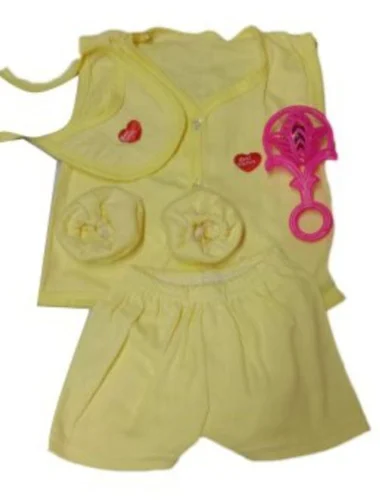
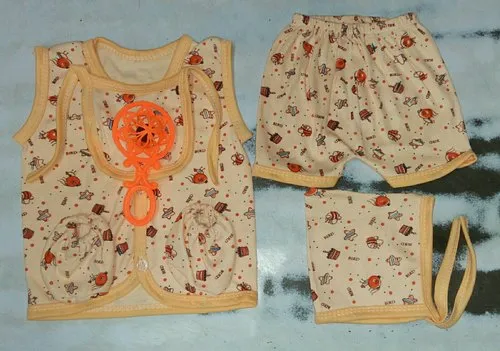
Girl Casual Wear Plain parkar cotton Newborn Baby Dress 6pis set
₹55.0
Occasion Casual Wear
Gender Girl
Color Yellow
Fabric Cotton
Pattern Plain
Packaging Type Packet
Set of Contain Toy,Shocks, Top, Pant, Bib
Hosiery cotton

Girl Cotton Dress Set:
Key features of eco-friendly garments include:
Eco-friendly clothing encompasses various aspects that make it a conscientious choice for both consumers and the environment. These aspects include:
Eco-friendly clothing often incorporates materials like organic cotton, hemp, Tencel, or recycled fibers. This deliberate choice reduces the need for pesticides and harmful chemicals during cultivation or production.
Manufacturers of eco-friendly garments prioritize water-efficient production processes. These practices aim to significantly decrease water consumption, particularly during the dyeing and finishing stages.
Sustainable fashion brands actively strive to reduce their carbon footprint. They achieve this by adopting renewable energy sources and employing efficient manufacturing methods.
Brands committed to sustainability ensure fair and safe working conditions for the individuals involved in the production of eco-friendly garments. This includes the guarantee of fair wages and the provision of safe work environments.
Environmentally responsible dyeing and printing methods are employed to minimize the use of harmful chemicals and reduce water waste.
Sustainable clothing brands design their garments with a focus on long-term use. This involves emphasizing quality, timeless designs, and durability to discourage disposable fashion trends.
Eco-friendly clothing can either undergo recycling or naturally break down, thereby significantly reducing textile waste in landfills.
Many brands source materials and manufacture their garments locally, reducing transportation-related carbon emissions.
Girl Cotton Dress Set: In summary, eco-friendly garments are emblematic of a move toward a more ethical and sustainable fashion industry. By choosing these clothing items, consumers play a pivotal role in promoting a cleaner, more responsible fashion ecosystem while still enjoying style and comfort.
For instance, consider our ‘Handloom Cushion Cover Set,’ meticulously designed to enhance the sophistication of your living spaces. Crafted from eco-friendly fabrics, these cushion covers not only effortlessly complement a range of decor styles but also add both style and sustainability to your home.
You must be logged in to post a review.
Q & A
Sustainability Assessment Report
Product: Newborn Baby Dress – Cotton Dress
Assessment Standard: Conducted in accordance with ISO 14040 and ISO 14044 Intended Use: Cleantech Mart sustainability scoring, ESG disclosure, and investor due diligence1. Goal & Scope Definition (ISO-Aligned)
Goal: To quantify cradle-to-gate environmental impacts of one (1) newborn half-sleeve cotton dress and provide sustainability indexing for Cleantech Mart. Functional Unit: 1 finished newborn cotton dress Average garment mass = 0.17 kg (100% cotton) System Boundary (Cradle-to-Gate):- Cotton cultivation
- Ginning & spinning
- Fabric formation
- Dyeing & finishing
- Garment manufacturing
- Primary packaging
2. Life Cycle Inventory (LCI) Assumptions
| Parameter | Value | Source |
|---|---|---|
| Cotton water footprint | 10,000 L/kg | Water Footprint Network |
| Cotton textile carbon intensity | 5.5 kg CO₂e/kg | Quantis |
| Textile processing energy | 4 kWh/kg | Industry LCA datasets |
| India electricity emission factor | 0.7 kg CO₂e/kWh | International Energy Agency |
3. Environmental Impact Calculations
3.1 Water Footprint
[ Water = 0.17 , kg × 10,000 , L/kg ] [ Water = 1,700 , liters ] Result: ≈ 1,700 liters of freshwater per dress, primarily due to irrigation during cotton cultivation.3.2 Carbon Footprint (Cradle-to-Gate)
(A) Raw Cotton Emissions
[ 0.17 × 5.5 = 0.935 , kg CO₂e ](B) Processing Energy Emissions
Energy use: [ 0.17 × 4 = 0.68 , kWh ] Emissions: [ 0.68 × 0.7 = 0.476 , kg CO₂e ]Total Carbon Footprint
[ 0.935 + 0.476 = 1.411 , kg CO₂e ] Final Carbon Footprint: ≈ 1.41 kg CO₂e per dress (cradle-to-gate)4. Environmental Interpretation (ISO 14044 §5)
Impact Hotspots
- Cotton irrigation (dominant water driver)
- Fertilizer-related nitrous oxide (N₂O) emissions
- Energy-intensive dyeing processes
Environmental Strengths
- Natural fiber (biodegradable under aerobic composting)
- No microplastic shedding (vs synthetic textiles)
- Breathable fabric suitable for infant health
5. Cleantech Mart Sustainability Scoring
| Category | Score (10) | Rationale |
|---|---|---|
| Carbon Efficiency | 6.7 | Moderate emissions per functional unit |
| Water Efficiency | 4.3 | Irrigation-intensive crop |
| Circularity | 8.5 | Biodegradable & recyclable fiber |
| Chemical & Toxicity Risk | 7 | Depends on dye compliance |
| Overall Sustainability Index | 6.6 / 10 |
6. Improvement Scenario
If upgraded to:- Organic cotton
- Renewable-powered textile processing
- Low-impact dyes
- Recycled paper packaging
7. ISO 14040/44 Conformity Statement
This assessment:- Defines a functional unit
- Establishes cradle-to-gate system boundary
- Uses secondary peer-reviewed datasets
- Applies transparent emission factor calculations
- Is suitable for ESG pre-disclosure and investor screening
References
- Water Footprint Network – Global cotton water footprint database
- Quantis – Apparel environmental impact assessments
- International Energy Agency – Electricity emission factors (India)
- ISO 14040 – Environmental management – LCA framework
- ISO 14044 – Environmental management – LCA requirements and guidelines
General Inquiries
There are no inquiries yet.
Reviews
There are no reviews yet.