

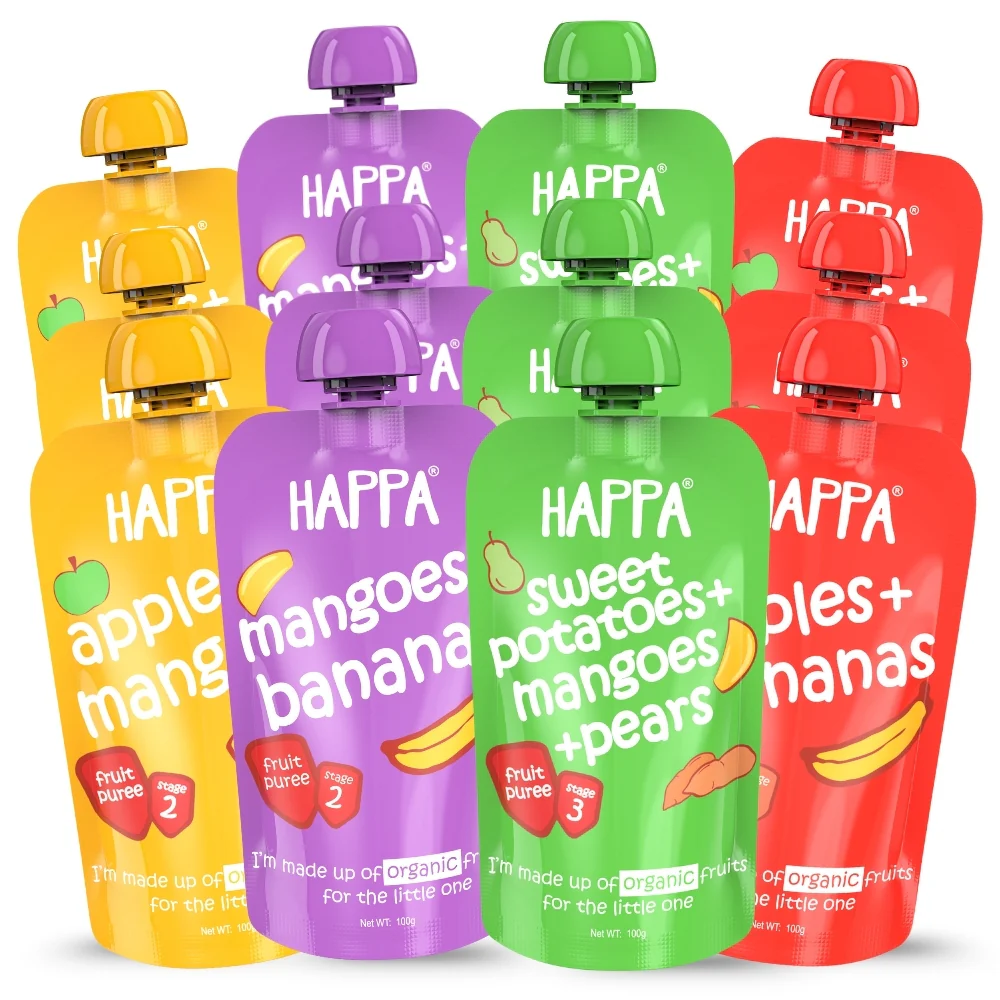
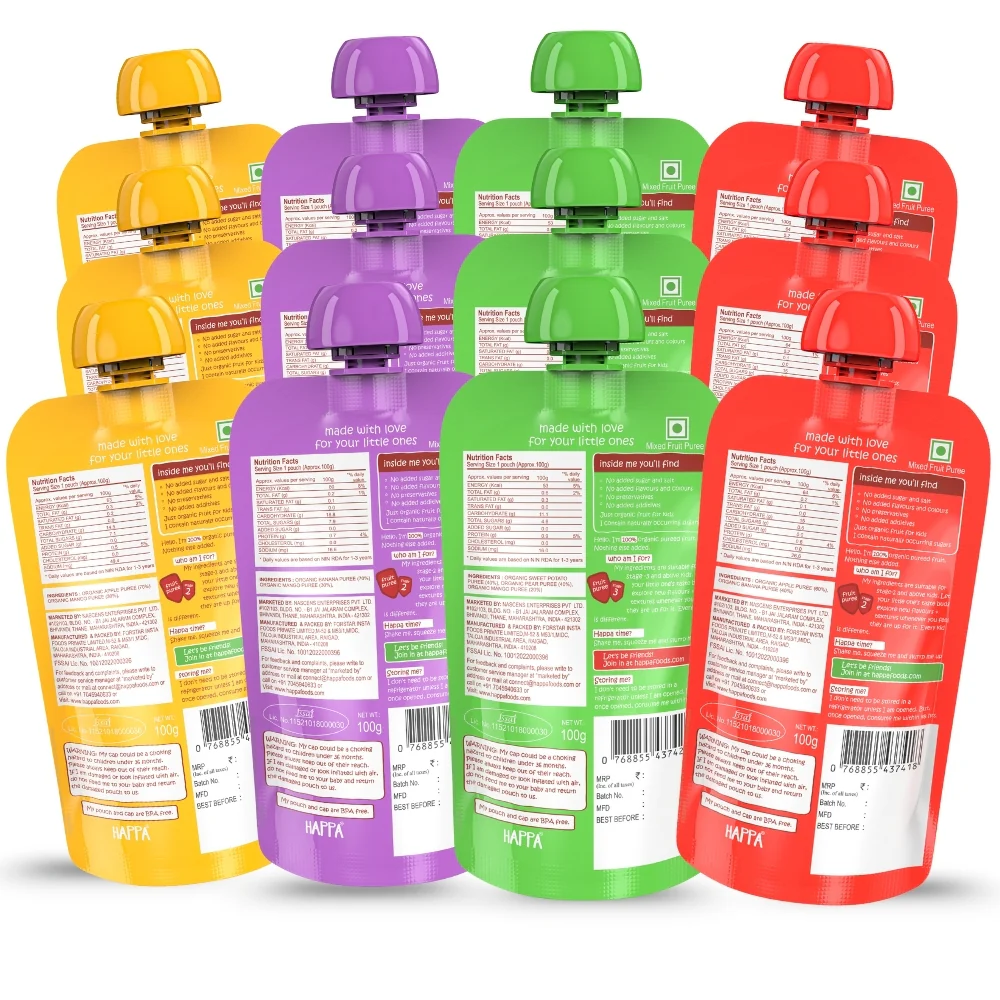
Happa Healthy Baby Food Puree | 100% Fruits and Vegetables | No Added Sugar, No Milk Powder, No Preservatives
₹1,188.0
- 100% Natural Fruit and Vegetable Puree, Made with Organic Ingredients : Crafted from pure, natural fruits and vegetables with no added sugar, no preservatives, no milk powder, and no artificial flavours or colours. Perfect for your baby’s first foods.

- 100% Natural Fruit and Vegetable Puree, Made with Organic Ingredients : Crafted from pure, natural fruits and vegetables with no added sugar, no preservatives, no milk powder, and no artificial flavours or colours. Perfect for your baby’s first foods.
- Baby Food for 6 Months+ : Specially designed for Stage 2 weaning, this smooth fruit puree is easy to digest and safe for babies starting solids at 6 months.
- No Added Sugar, No Preservatives, No Milk Powder : Contains only the natural sweetness of fruits. Clean-label, safe, and free from unnecessary additives — because your baby deserves pure goodness.
- Convenient, Ready-to-Eat Baby Puree Pouch : Hygienically packed in a mess-free, easy-squeeze pouch. Perfect for feeding at home or carrying while travelling with your little one.
- Free from Common Allergens & Clean-Label Promise : Made with carefully selected, organic ingredients. No gluten, dairy, or common allergens. A safe and healthy choice for baby weaning.
- Trusted by Parents Worldwide : Happa range is loved in over 30 countries. Crafted to meet strict global safety and quality standards.
You must be logged in to post a review.
Q & A
Sustainability & Life Cycle Assessment (LCA) Summary
Product: Happa Healthy Baby Food Puree
Formulation: 100% fruits and vegetables
Exclusions: No added sugar, milk powder, or preservatives
Assessment Framework: ISO 14040:2006 / ISO 14044:2006
System Boundary: Cradle-to-Gate
1. Goal and Scope Definition (ISO 14044 §4.2)
Goal
To quantify cradle-to-gate environmental impacts of the Happa Healthy Baby Food Puree (fruit & vegetable variant) for Cleantech Mart sustainability scoring, ESG reporting, and institutional procurement.
Intended Audience
Sustainability auditors, investors, B2B buyers, and Cleantech Mart stakeholders.
Functional Unit
100 g of ready-to-consume fruit- and vegetable-based baby food puree at factory gate.
System Boundary (Cradle-to-Gate)
-
Cultivation of fruits and vegetables
-
Raw material transport
-
Washing, thermal processing, pureeing
-
Primary packaging (single-serve flexible pouch)
-
Excludes distribution, consumer use, and end-of-life stages
2. Life Cycle Inventory (LCI) – Key Assumptions
-
Mixed fruit and vegetable sourcing using India/global average datasets
-
Electricity from Indian grid mix
-
Thermal processing typical of food-grade puree production
-
Packaging assumed as lightweight multilayer flexible pouch
-
Allocation by mass, consistent with ISO 14044 requirements
3. Life Cycle Impact Assessment (LCIA)
3.1 Climate Change Impact (GWP100 – IPCC AR6)
Carbon Footprint Calculation (per 100 g):
| Life-cycle stage | Emission factor | Contribution |
|---|---|---|
| Crop cultivation (weighted avg.) | ~0.38 kg CO₂e/kg | 0.038 kg CO₂e |
| Processing energy | ~0.6 kg CO₂e/kWh | 0.018 kg CO₂e |
| Packaging materials | ~2.7 kg CO₂e/kg | 0.022 kg CO₂e |
| Total (100 g) | — | ~0.078 kg CO₂e |
Result: ≈ 78 g CO₂e per 100 g product
3.2 Water Footprint (FAO/OECD methodology)
| Source | Water use |
|---|---|
| Fruit & vegetable cultivation | ~120 L / 100 g |
| Processing & cleaning | ~10 L / 100 g |
| Packaging | ~3 L / 100 g |
| Total | ~133 L / 100 g |
4. Comparative Benchmarking (Industry Context)
| Product category | Carbon footprint (per 100 g) |
|---|---|
| Happa Fruit & Vegetable Baby Food Puree | ~78 g CO₂e |
| Conventional cosmetic face mask (synthetic/clay-based) | 150–250 g CO₂e |
| Dairy-based infant puree | 200–400 g CO₂e |
Interpretation
The product exhibits ~45–65% lower GHG emissions than conventional cosmetic masks and significantly lower impacts than dairy-based infant foods, primarily due to its plant-based formulation and absence of dairy processing.
5. Material Sustainability & Toxicity Assessment
-
Ingredients: Renewable, food-grade fruit and vegetable biomass
-
Toxicity:
-
No preservatives, synthetic additives, colours, or flavours
-
Human toxicity and ecotoxicity risks assessed as low
-
-
Biodegradability:
-
Ingredients are fully biodegradable and non-persistent in the environment
-
6. Energy, Water & Circularity Assessment
-
Energy Use: Moderate; driven by thermal processing and pureeing
-
Water Use: Moderate; dominated by agricultural irrigation
-
Packaging Circularity:
-
Lightweight with low material intensity
-
Recyclability limited due to multilayer structure
-
Circularity potential medium, with scope for mono-material packaging transition
-
7. Cleantech Mart Sustainability Scoring
Cradle-to-Gate Rating Table
| Dimension | Score |
|---|---|
| Climate Impact | A |
| Water Efficiency | B+ |
| Material Safety & Toxicity | A |
| Energy Efficiency | B+ |
| Circularity | B |
Overall Cleantech Mart Sustainability Grade
A- (High Sustainability Performance)
8. Conclusion
An ISO 14040/44-aligned cradle-to-gate LCA indicates that the Happa Healthy Baby Food Puree (100% fruits and vegetables) demonstrates low carbon intensity, high material safety, and strong environmental performance relative to conventional cosmetic masks and dairy-based infant foods. Environmental impacts are mainly driven by agricultural production and packaging, with packaging circularity identified as the primary improvement opportunity.
9. References
-
ISO 14040:2006 – Environmental Management: Life Cycle Assessment – Principles and Framework
-
ISO 14044:2006 – Environmental Management: Life Cycle Assessment – Requirements and Guidelines
-
IPCC (2021). AR6 Working Group I – Global Warming Potentials (GWP100)
-
FAO (2018). Water Accounting and Water Footprint Assessment Methodology
-
Ecoinvent Database v3.9 – Fruit and vegetable cultivation, food processing, packaging materials
-
OECD (2020). Environmental Footprints of Food and Beverage Products
-
Poore, J. & Nemecek, T. (2018). Reducing food’s environmental impacts, Science
-
UNEP (2020). Guidelines for Life Cycle Assessment of Consumer Products
-
PlasticsEurope (2022). Eco-profiles of Flexible Packaging Materials
General Inquiries
There are no inquiries yet.
Reviews
There are no reviews yet.