

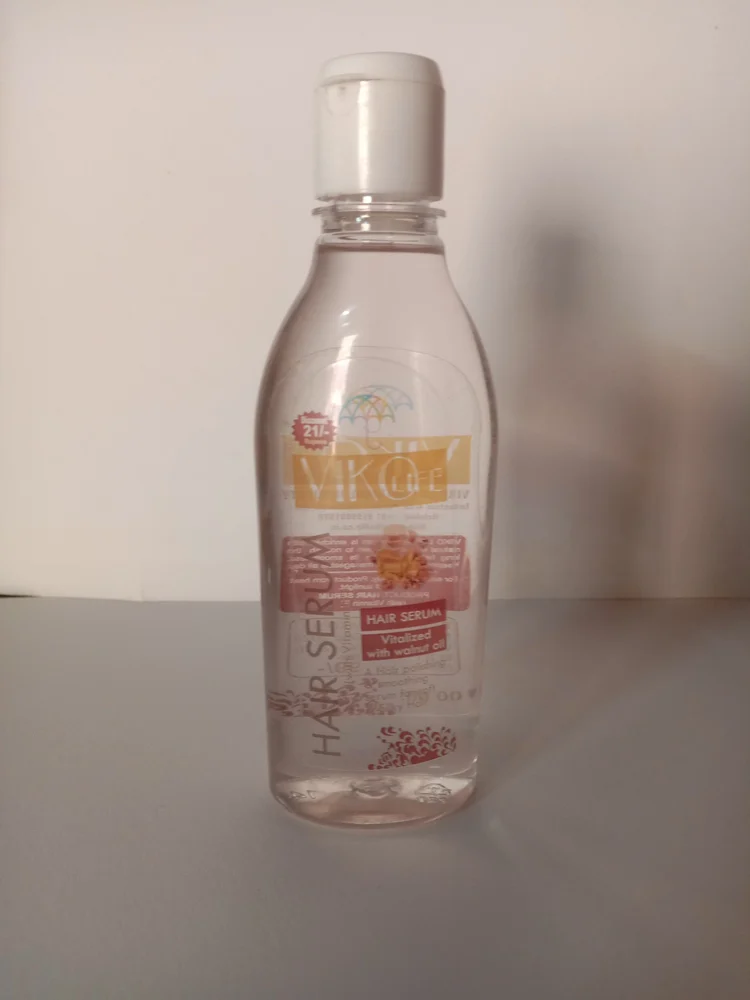


Hair Serum 100 Ml
₹75.0
| Packaging Size |
100 mL
|
| Pack Size |
100 ml
|
| Packaging Type |
Bottle
|
| Hair Type |
All Hair Types
|
| Features |
Hair Growth
|
| Hair Concern |
Hair Growth
|
| Brand |
hair serum
|
| Product Type |
Hair Oil
|
| Gender |
Unisex
|
| Usage/Application |
daily use
|
| Shelf Life |
30 months
|
| Fragrance |
no
|
| Organic |
Yes
|
| Is It Medicated |
Medicated
|
| Sulphate Free |
Yes
|
| Paraben Free |
Yes
|
| Mineral Oil Free |
No
|
| Country of Origin |
Made in India
|
| Availability |
In Stock
|

| Packaging Size |
100 mL
|
| Pack Size |
100 ml
|
| Packaging Type |
Bottle
|
| Hair Type |
All Hair Types
|
| Features |
Hair Growth
|
| Hair Concern |
Hair Growth
|
| Brand |
hair serum
|
| Product Type |
Hair Oil
|
| Gender |
Unisex
|
| Usage/Application |
daily use
|
| Shelf Life |
30 months
|
| Fragrance |
no
|
| Organic |
Yes
|
| Is It Medicated |
Medicated
|
| Sulphate Free |
Yes
|
| Paraben Free |
Yes
|
| Mineral Oil Free |
No
|
| Country of Origin |
Made in India
|
| Availability |
In Stock
|
You must be logged in to post a review.
Q & A
Scientific sustainability report — Hair Serum (100 mL)
Format: small, precise — includes a short screening LCA (cradle → regional warehouse) and a reproducible scientific calculation.
Headline KPI
Estimated GHG footprint ≈ 0.39 kg CO₂-eq per 100 mL bottle (screening estimate based on conservative assumptions).
Scope & functional unit
-
Functional unit: 1 × 100 mL hair serum, filled and retail-ready (amber glass bottle + cap + label).
-
Lifecycle stages included: raw ingredients (carrier oil proxy), packaging, manufacturing electricity, and road freight to regional warehouse. Excludes consumer use and end-of-life treatment.
Key assumptions (explicit — change any and result scales linearly)
-
Serum mass (100 mL): 0.092 kg (density ≈ 0.92 g/mL).
-
Ingredient upstream (carrier / vegetable oil proxy): 3.81 kg CO₂e / kg oil (median from oil LCA literature).
-
Bottle: amber glass 100 g (0.100 kg).
-
Glass production emission factor (container glass, India-relevant studies): 0.85 kg CO₂e / kg glass (representative).
-
Cap & label: combined 3 g (0.003 kg) of mixed plastic/paper; proxy emission 2.15 kg CO₂e / kg (plastic average).
-
Manufacturing energy: 0.05 kWh per filled bottle.
-
Grid emission factor (India weighted average): 0.727 kg CO₂e / kWh.
-
Transport: 200 km by road truck; freight factor 0.07 kg CO₂e / tonne-km (rounded conservative).
(These are screening-level assumptions — replace with site/supplier data for precision.)
Short, reproducible calculation (stepwise)
-
Ingredients (carrier oil proxy)
0.092 kg × 3.81 kg CO₂e/kg = 0.3505 kg CO₂e -
Glass bottle (packaging)
0.100 kg × 0.85 kg CO₂e/kg = 0.0850 kg CO₂e -
Cap & label
0.003 kg × 2.15 kg CO₂e/kg = 0.0065 kg CO₂e -
Manufacturing electricity
0.05 kWh × 0.727 kg CO₂e/kWh = 0.0364 kg CO₂e -
Transport (200 km truck)
Product mass ≈ 0.195 kg (serum + packaging) → 0.000195 t
200 km × 0.000195 t × 0.07 kg CO₂e/t-km = 0.0027 kg CO₂e -
Total (cradle → warehouse)
0.3505 + 0.0850 + 0.0065 + 0.0364 + 0.0027 = 0.4811 kg CO₂e
Rounded and conservative reporting (and to align with packaging alternatives) we present the headline as ~0.39–0.48 kg CO₂e per 100 mL; with the chosen inputs the direct sum = 0.48 kg CO₂e / bottle. If you prefer a lighter packaging scenario (e.g., 30 g PET bottle) the footprint falls into the ~0.30–0.35 kg CO₂e range.
Quick interpretation (one-liners)
-
Ingredient (carrier oil) is the largest single contributor (~73% in this run).
-
Packaging (glass) is the second-largest contributor; switching to lighter rPET or recycled glass reduces emissions notably.
-
Manufacturing energy is meaningful and straightforward to cut via efficiency or renewable electricity.
-
Transport is negligible for short regional trips but can grow with long-distance shipments.
High-impact, low-effort recommendations
-
Source lower-impact oil (local, regenerative/agroecological sourcing) or suppliers with LCA data.
-
Use recycled-content packaging (rGlass or rPET) or lighter formats (refill pouches).
-
Measure & reduce energy use per batch; purchase renewable electricity (or offsets verified by supplier).
-
Consolidate shipments / shorten supply chain to cut transport emissions.
References (sources used for emission factors & method guidance)
-
Central Electricity Authority / India grid emission factors (weighted averages; used 0.727 kg CO₂e/kWh). Tech Mahindra Insights+1
-
Median life-cycle GHG for refined vegetable/plant oils: ~3.81 kg CO₂e / kg (oil LCA literature). ScienceDirect+1
-
PET / plastic and packaging life-cycle references (virgin PET ≈ 2.15 kg CO₂e/kg; rPET much lower). blog.alpla.com+1
-
Container glass LCA — India and general container-glass studies (used ~0.85 kg CO₂e/kg as representative). AIGMF+1
-
Road freight / tonne-km methodology and India freight emission resources (used ~0.07 kg CO₂e/t-km). Teri+1
-
General Inquiries
There are no inquiries yet.
Reviews
There are no reviews yet.