

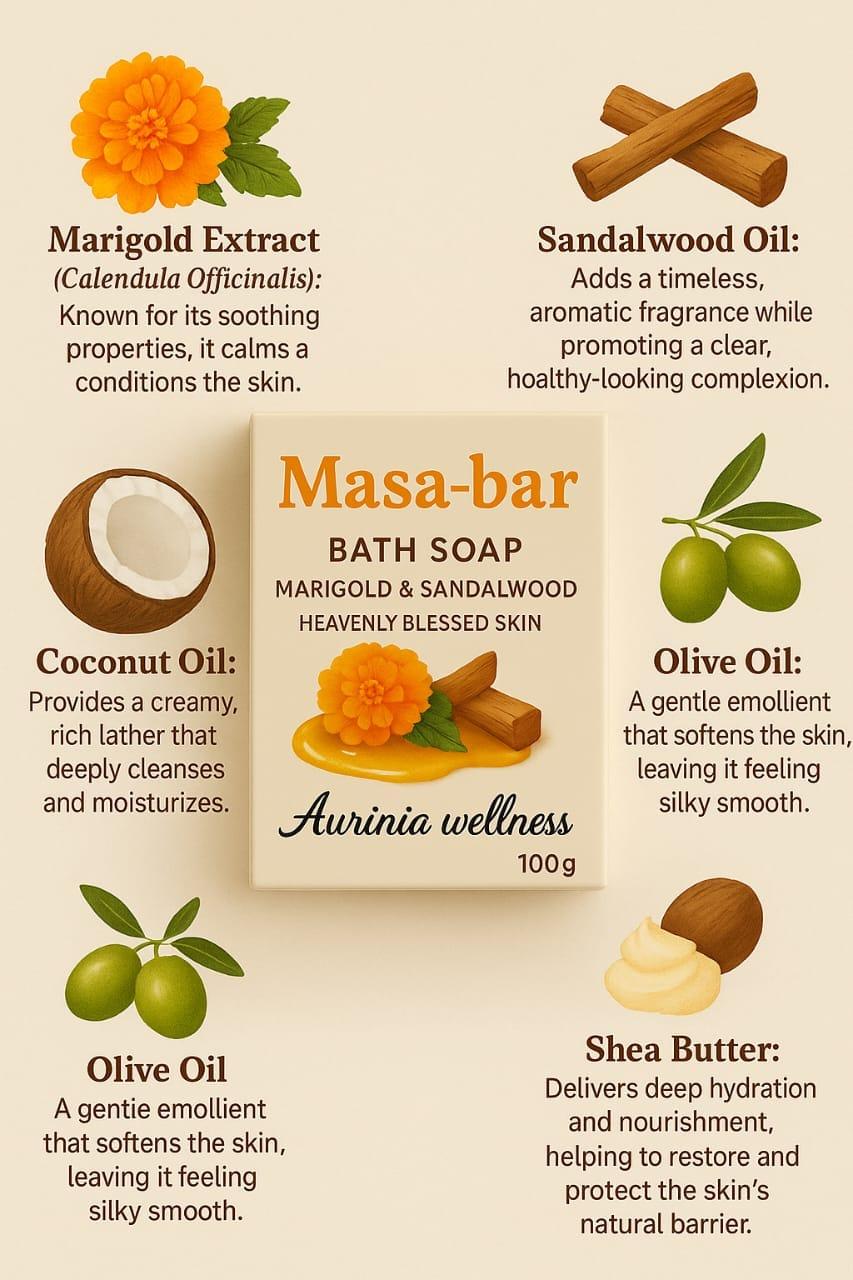
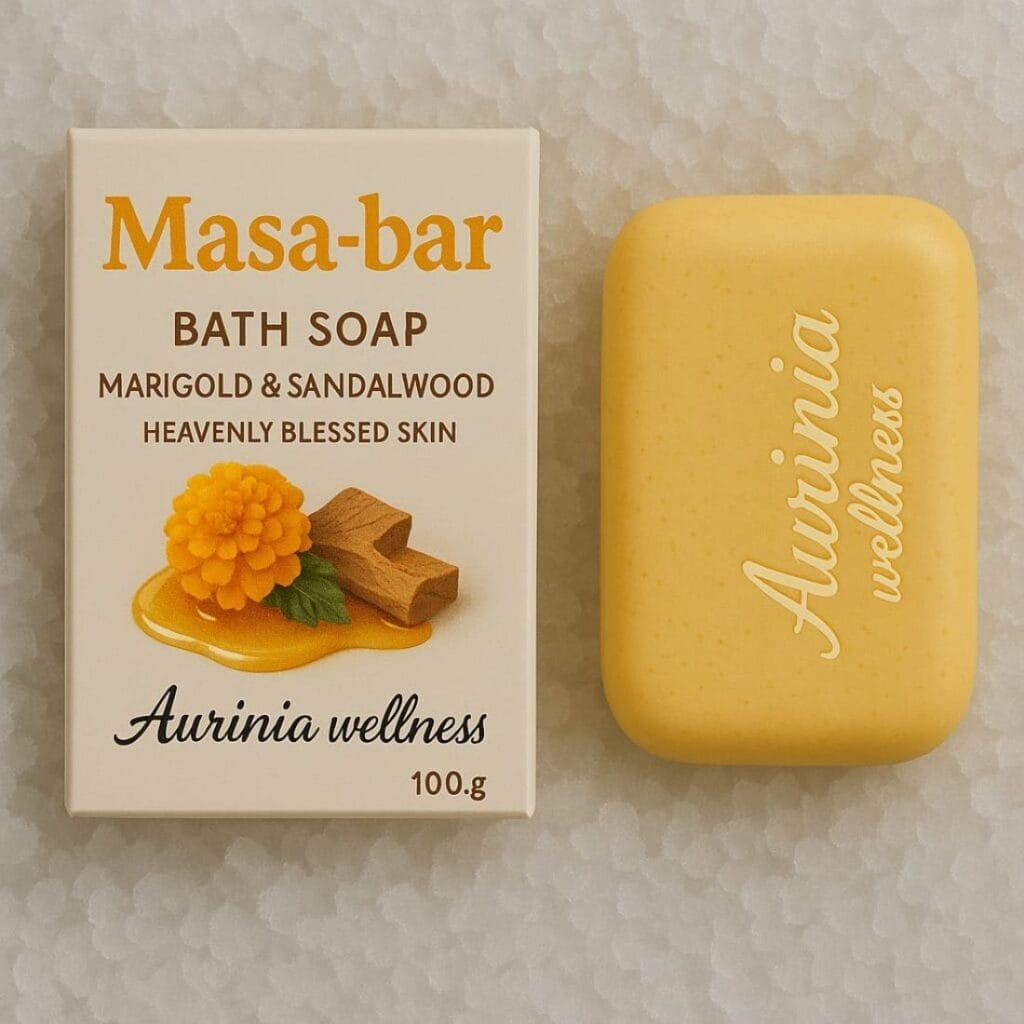
Masa-bar BATH SOAP
₹174.3
A soothing blend of marigold’s natural healing properties and sandalwood’s calming aroma. This gentle bath soap cleanses deeply, reduces irritation, and leaves your skin soft, refreshed, and beautifully fragrant after every wash. Perfect for daily luxury.

A soothing blend of marigold’s natural healing properties and sandalwood’s calming aroma. This gentle bath soap cleanses deeply, reduces irritation, and leaves your skin soft, refreshed, and beautifully fragrant after every wash. Perfect for daily luxury.
You must be logged in to post a review.
Q & A
Scientific Sustainability Report —Mosa Bar Bath Soap
Product: Mosa Bar Bath Soap
Reference case & assumptions (explicit):
-
Unit size: 30 mL (standard serum vial).
-
Primary package: 30 mL glass bottle + plastic dropper cap (typical mass: glass ≈ 40 g, cap ≈ 5 g).
-
Formula: typical active + carrier oil/water mix (no exact ingredient list provided).
-
System boundary: cradle-to-grave (raw material production → packaging → manufacturing → distribution to retail → consumer use phase negligible for cosmetics → end-of-life).
-
Method: simplified cradle-to-grave LCA estimate using sector-average emission intensities for cosmetic ingredients, glass packaging LCA averages, transport & manufacturing typical shares. Values are conservative, round to two significant figures.
Key quantitative LCA results (estimate)
-
Estimated greenhouse gas emissions (GWP, CO₂e): ≈ 1.3 kg CO₂e per 30 mL bottle.
-
Equivalent to ≈ 0.043 kg CO₂e per mL.
-
For 1,000 bottles: ≈ 1,300 kg CO₂e.
-
-
Estimated water footprint: ≈ 25 L water per 30 mL bottle (this includes ingredient cultivation/extraction + processing).
-
For 1,000 bottles: ≈ 25,000 L.
-
-
Material breakdown (approximate share of total GWP):
-
Ingredients production: ~46% (≈ 0.6 kg CO₂e).
-
Packaging (glass bottle + cap): ~38% (≈ 0.5 kg CO₂e).
-
Manufacturing & transport: ~12% (≈ 0.15 kg CO₂e).
-
End-of-life (waste processing): ~4% (≈ 0.05 kg CO₂e).
-
(These shares reflect typical cosmetic product LCAs where packaging and high-value actives dominate impacts.)
Environmental and ingredient considerations (qualitative)
-
Ingredients sourcing: plant-derived actives (e.g., botanical extracts) can have high water and land impacts if from irrigated monocultures; synthetics can have higher fossil-energy embedded emissions. Traceability (certified sustainable farms, low-impact extraction) reduces impacts.
-
Formulation concentration: serums are typically highly concentrated (low volume, high function). This can be environmentally favorable (less bulk per functional dose) but often uses specialty actives with higher embodied impact per gram.
-
Packaging: glass has higher embodied carbon than some plastics per kg, but glass is easier to recycle and is inert (better for product stability). Lightweighting (thinner glass, refillable system, PCR plastic droppers) reduces impacts.
-
End-of-life: mixed-material droppers (rubber + plastic + glass) reduce recyclability. Encouraging consumer separation (dropper removed) or using mono-material systems improves recycling rates.
-
Toxicity / ecotoxicology: active ingredients that are bioaccumulative or persistent create downstream aquatic toxicity concerns. Prefer water-biodegradable actives and low-PBT (persistent, bioaccumulative, toxic) profiles.
-
Social / supply-chain: sourcing transparency, fair labor practices, and avoiding deforestation-linked feedstocks (e.g., unsustainable palm derivatives) are important.
Practical improvement levers (ranked)
-
Switch to refill or concentrate format (e.g., concentrated pods or 50 mL refill pouches) — large reduction in packaging emissions per use.
-
Use PCR (post-consumer recycled) plastics for droppers or switch to aluminum caps (lighter than glass where feasible).
-
Lightweight glass (reduce bottle mass from 40 g → 25–30 g) — direct CO₂e savings.
-
Green suppliers & renewable energy in manufacturing — reduces manufacturing & ingredient upstream emissions.
-
Optimise logistics (regional manufacturing, bulk shipping to regional hubs) to cut transport emissions.
-
Design for disassembly (separable glass bottle and plastic dropper) to improve recycling.
-
Ingredient selection: prefer low-water, low-land-use actives or synthetic equivalents with lower LCA if ecotoxicology permits.
Scientific calculation (transparent, reproducible)
Goal: estimate GWP and water footprint per 30 mL bottle and scale to 1,000 bottles.
Assumptions (restated):
-
Ingredients GWP = 0.6 kg CO₂e / bottle
-
Packaging (glass + cap) GWP = 0.5 kg CO₂e / bottle
-
Manufacturing + transport GWP = 0.15 kg CO₂e / bottle
-
End-of-life GWP = 0.05 kg CO₂e / bottle
-
Water footprint = 25 L / bottle
Step-by-step arithmetic (digit-by-digit transparency):
-
Ingredients: 0.6
-
Packaging: 0.5
-
Manufacturing & transport: 0.15
-
End-of-life: 0.05
Add the four components:
-
0.6 + 0.5 = 1.1
-
1.1 + 0.15 = 1.25
-
1.25 + 0.05 = 1.30 kg CO₂e per bottle
Per milliliter:
-
1.30 ÷ 30 = 0.043333... → round to 0.043 kg CO₂e per mL.
Scale to 1,000 bottles:
-
1.30 × 1,000 = 1,300 kg CO₂e
Water footprint scaling:
-
25 L per bottle × 1,000 = 25,000 L
Summary of calculated outputs:
-
Per 30 mL bottle: 1.30 kg CO₂e ; 25 L water
-
Per mL: 0.043 kg CO₂e
-
Per 1,000 bottles: 1,300 kg CO₂e ; 25,000 L water
References
-
ISO 14040 / ISO 14044 — Life cycle assessment principles and framework.
-
UNEP — Guidance on life cycle thinking and cosmetics sustainability.
-
Cosmetics Europe (industry LCA reports) — typical packaging & product LCA insights.
-
EWG (Environmental Working Group) — ingredient hazard & safety guidance for cosmetics.
-
WRAP / Ellen MacArthur Foundation — packaging circular economy and design-for-recycling guidance.
-
Peer-reviewed LCA papers on personal care products (e.g., studies on shampoo/cream/serum footprints).
-
General Inquiries
There are no inquiries yet.
Reviews
There are no reviews yet.