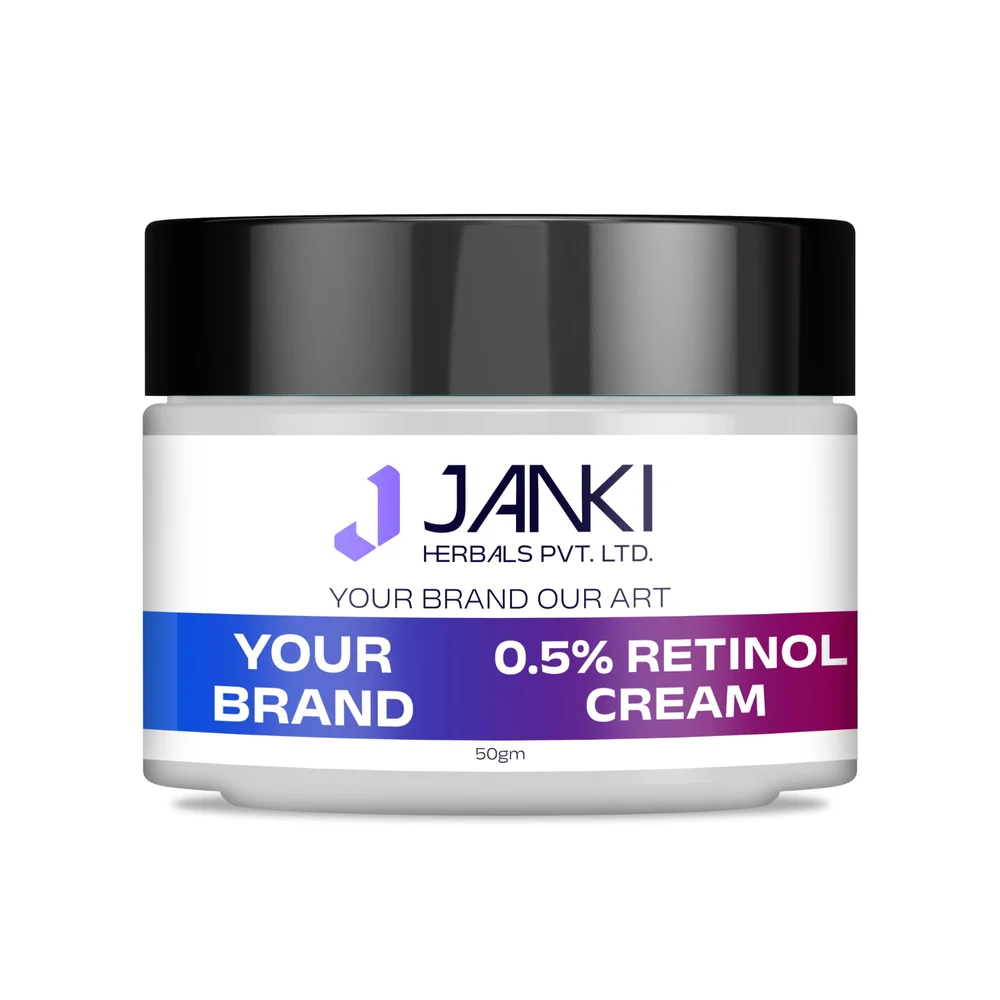
Scientific Report: Sustainability of 0.5% Retinol Cream
1. Introduction
Retinol (vitamin A₁) is a potent antioxidant and cell-regulating agent widely used in skincare for its anti-aging and skin-rejuvenating properties. A 0.5% retinol concentration is commonly utilized in over-the-counter formulations. However, its environmental impact, particularly concerning production, stability, and biodegradability, necessitates a comprehensive sustainability assessment.
2. Environmental Impact Assessment
2.1 Raw Material Sourcing
Traditional retinol is derived from animal sources, which are resource-intensive and contribute to greenhouse gas emissions, deforestation, and water pollution. In contrast, biotechnological advancements have enabled the production of synthetic and plant-based retinol through precision fermentation, utilizing renewable resources and exhibiting a lower environmental footprint .
2.2 Stabilization and Additives
Retinol is inherently unstable, degrading upon exposure to light, oxygen, and heat. Conventional stabilizers like butylated hydroxytoluene (BHT) and ethylenediaminetetraacetic acid (EDTA) are effective but pose environmental concerns due to their toxicity and persistence. Recent studies have identified more eco-friendly alternatives, such as [S,S]-ethylenediamine disuccinic acid (EDDS) and pentaerythritol tetrakis(3,5-di-tert-butyl-4-hydroxyhydrocinnamate) (PBHC), which offer improved biodegradability and reduced environmental impact .
2.3 Biodegradability and Aquatic Toxicity
Retinol demonstrates low toxicity to aquatic organisms and is readily biodegradable, posing minimal environmental hazard. In contrast, its oxidation product, retinal, is less biodegradable and may exhibit greater toxicity to aquatic systems. Therefore, the degradation products of retinol should also be considered in environmental assessments .
3. Regulatory Considerations
The European Union's Scientific Committee on Consumer Safety (SCCS) has set maximum concentrations for retinol in cosmetic products to mitigate potential health risks. For body lotions, the limit is 0.05% retinol equivalents, while for leave-on and rinse-off products, including face creams, the limit is 0.3% retinol equivalents . These regulations aim to balance efficacy with safety, ensuring consumer protection.
4. Sustainability Metrics
Utilizing the Sustainable Product Optimization Tool (SPOT), formulations containing [S,S]-EDDS and PBHC stabilizers achieved a sustainability score of 10, surpassing the 8.84 score of formulations using BHT and EDTA. This indicates a more favorable environmental profile for the eco-friendly stabilizer combination .
5. Conclusion
A 0.5% retinol cream, when formulated with sustainable practices, can offer effective skincare benefits with a reduced environmental impact. Advancements in biotechnological production of retinol and the adoption of eco-friendly stabilizers contribute to the sustainability of such formulations. Adhering to regulatory standards ensures both consumer safety and environmental responsibility.
6. References
-
Zasada, M., Budzisz, E., & Erkiert-Polguj, A. (2020). A Clinical Anti-Ageing Comparative Study of 0.3 and 0.5% Retinol Serums: A Clinically Controlled Trial. Skin Pharmacology and Physiology, 33(2), 102–116. https://doi.org/10.1159/000508168
-
Wang, Y., et al. (2023). An eco‐friendly system for stabilization of retinol: A step towards attending performance with improved environmental respect. International Journal of Cosmetic Science. https://doi.org/10.1111/ics.12853
-
CommonShare. (2025). Retinol. Retrieved from https://www.commonshare.com/materials/retinol
-
Cosmetics Info. (n.d.). Retinol. Retrieved from https://www.cosmeticsinfo.org/ingredient/retinol/
-
Malvern Panalytical. (n.d.). Optimizing topical skin care formulations and production. Retrieved from https://www.malvernpanalytical.com/es/learn/knowledge-center/application-notes/an101104topicalskincareformulations
-
Personal Care Science. (2022). Formulating with Vitamin A in skincare. Retrieved from https://personalcarescience.com.au/Workshops/cosmeticscienceworkshops-2110/Blog-4192/FormulatingwithVitaminAinskincare-7501/
-
PubMed. (2016). Efficacy and Tolerability of a Skin Brightening/Anti-Aging Cosmeceutical Containing Retinol 0.5%, Niacinamide, Hexylresorcinol, and Resveratrol. J Drugs Dermatol, 15(7), 863–868. Retrieved from https://pubmed.ncbi.nlm.nih.gov/27391637/
-
PubMed. (2013). Treatment of facial photodamage using a novel retinol formulation. Retrieved from https://pubmed.ncbi.nlm.nih.gov/23652947/
-
PubMed Central. (2022). Retinol semisolid preparations in cosmetics: transcutaneous permeation mechanism and behaviour. Retrieved from https://pmc.ncbi.nlm.nih.gov/articles/PMC11445495/
-
PubMed Central. (2023). Usage Frequency and Ecotoxicity of Skin Depigmenting Agents. Retrieved from https://pmc.ncbi.nlm.nih.gov/articles/PMC11945762/
-
StudyLib. (n.d.). Retinoid Stability in Cosmetics: Kinetics & Degradation. Retrieved from https://studylib.net/doc/26156041/10.1111%40jocd.13852
-
Vogue Business. (2023). What the new retinol rules mean for beauty brands. Retrieved from https://www.voguebusiness.com/story/beauty/what-the-new-retinol-rules-mean-for-beauty-brands
🔒
Full Sustainability Report
Unlock the complete AI-powered lifecycle analysis — certifications, verdict, carbon comparison & more.
✅ Usage Phase impact
✅ End-of-Life data
✅ Key Highlights
✅ Certifications
✅ Final Verdict
🌿
Want Your Own Company ESG Report?
Generate a full BRSR-aligned ESG report for your organisation — AI-powered, Gemini-backed, with a CM Carbon Rating (A–E).
🔑 Login & Calculate ESG