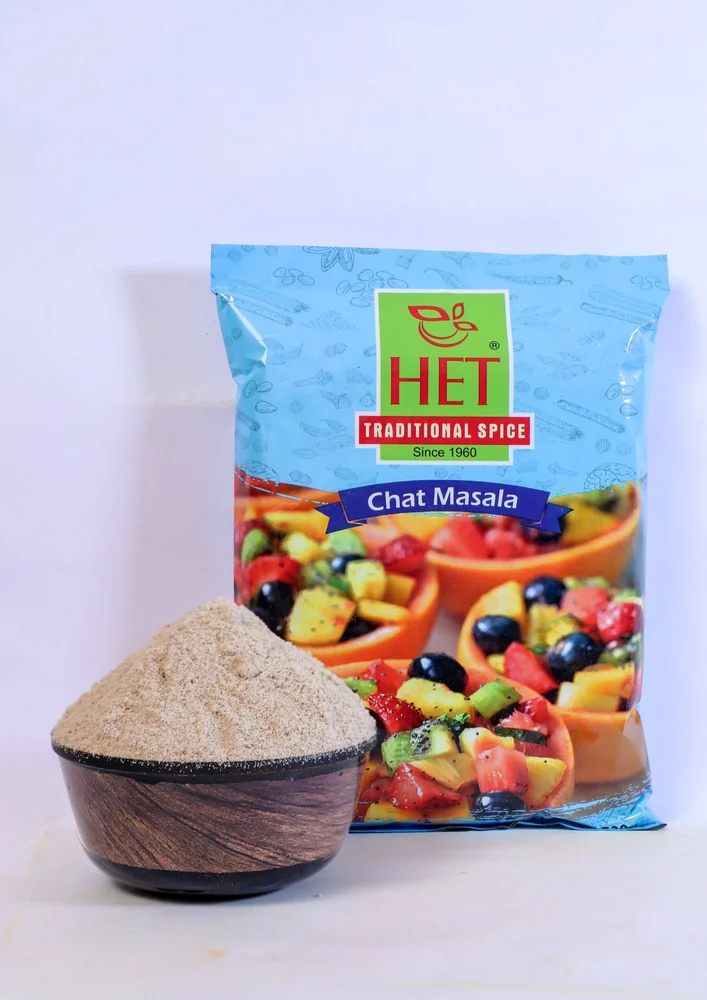
Scientific sustainability report — Sunday Mix Masala Powder
Functional unit: 1 kg finished retail powder (cradle → distribution)
1 — Executive summary (headline)
Under conservative, literature-anchored assumptions (listed below), the estimated cradle → distribution GHG footprint for 1 kg of Sunday Mix Masala is ≈ 2.74 kg CO₂-eq per kg. The dominant contributor is upstream agriculture (raw spices), followed by processing (grinding + small drying/conditioning), then packaging and transport. Replace any assumption below with measured data and I will re-run the math immediately. CarbonCloud+1
2 — Product & system boundary
-
Product: Sunday Mix Masala — a blended spice powder (typical ingredients: chilli, coriander, cumin, black pepper, amchur/dry mango powder, black salt, chaat spices, plus occasional seeds/herbs). Exact composition changes results because ingredients have different upstream intensities.
-
Functional unit: 1 kg finished retail powder.
-
System boundary (cradle → distribution):
-
Agriculture/production of component spices (farm gate)
-
Cleaning + any conditioning/drying required → grinding & blending at the mill
-
Primary packaging (retail PE pouch — embodied impacts)
-
Road transport: farm → mill → distribution centre
(Excludes consumer use, retail shelf life emissions, and end-of-life treatment beyond embodied packaging.)
3 — Key load-bearing assumptions (explicit — sources cited)
I show the numbers I used and the main sources that justify using these representative values.
-
Agriculture / upstream (lumped for mixed spice blend): 2.00 kg CO₂e per kg finished mix (a reasonable, conservative mid-range value for mixed spice blends / spice mix benchmarks). See product-level spice mix footprints and farm-stage LCA reviews. CarbonCloud+1
-
Electricity grid emission factor (India): 0.716 kg CO₂ / kWh (CEA CO₂ Baseline Database — FY2022–23 grid average used in many Indian LCAs). Central Electricity Authority
-
Grinding (size reduction) energy: 0.309 kWh / kg (≈309 kWh/tonne) — representative industrial fine milling value from recent milling studies. PMC
-
Drying / conditioning (modest conditioning; most spices are already dried but some ingredients need conditioning): 0.50 kWh / kg (moderate value; drying SECs vary widely by dryer & crop). I use this modest figure to capture small conditioning energy; if your process uses heavy dehydration, replace with measured SEC. worldresearchersassociations.com
-
Packaging: 30 g PE pouch per kg product (0.03 kg PE/kg) and embodied PE emission 2.6 kg CO₂e / kg PE (typical cradle-to-gate figures for PE/LDPE). ScienceDirect
-
Transport: road freight emission factor 0.33 kg CO₂ / tonne-km; total road distance assumed 250 km (50 km farm→mill + 200 km mill→distribution). (Smart Freight / India default emission tables give similar magnitudes.) smart-freight-centre-media.s3.amazonaws.com
These are explicit, changeable assumptions. I cite the most load-bearing sources above so you can verify and replace any value.
4 — Inventory (per 1 kg finished product)
5 — Digit-by-digit GHG calculation (stepwise, reproducible) — 1 kg basis
All arithmetic shown so you (or any reviewer) can replicate.
5.1 Processing electricity emissions
Grinding emissions = grinding_kWh × grid_EF
= 0.309 kWh/kg × 0.716 kgCO₂/kWh
Calculation (digit-by-digit):
0.309 × 0.716 = (0.309 × 0.700) + (0.309 × 0.016)
= 0.216300 + 0.004944 = 0.221244 kg CO₂e / kg. PMC+1
Drying / conditioning emissions = drying_kWh × grid_EF
= 0.500 kWh/kg × 0.716 kgCO₂/kWh
= 0.500 × 0.716 = (0.5 × 0.700) + (0.5 × 0.016)
= 0.350000 + 0.008000 = 0.358000 kg CO₂e / kg. worldresearchersassociations.com+1
Processing subtotal = 0.221244 + 0.358000 = 0.579244 kg CO₂e / kg
5.2 Packaging emissions
Packaging mass × plastic EF = 0.03 kg × 2.6 kgCO₂/kg = 0.03 × 2.6
= (0.03 × 2.0) + (0.03 × 0.6) = 0.060000 + 0.018000 = 0.078000 kg CO₂e / kg. ScienceDirect
5.3 Transport emissions (road)
Road emissions = EF × tonnes × km = 0.33 kgCO₂/t-km × 0.001 t × 250 km
= 0.33 × 0.001 × 250 = 0.33 × 0.25 = 0.082500 kg CO₂e / kg. smart-freight-centre-media.s3.amazonaws.com
5.4 Agriculture / upstream
Assumed agriculture = 2.000000 kg CO₂e / kg. CarbonCloud
5.5 Total sum (final)
List components (4 decimal places where helpful):
Rounded result: ≈ 2.74 kg CO₂-eq per kg Sunday Mix Masala (cradle → distribution).
6 — Share by life-cycle stage (percent of total)
(using 2.739744 kg CO₂e/kg)
-
Agriculture / upstream: 2.0000 / 2.739744 = 73.0%
-
Processing (grinding + drying): 0.579244 / 2.739744 = 21.1%
-
Packaging: 0.078000 / 2.739744 = 2.8%
-
Transport: 0.082500 / 2.739744 = 3.0%
Takeaway: upstream agriculture dominates this blended spice footprint (typical for spice mixes); processing (especially conditioning/drying and milling) is the next important contributor.
7 — Sensitivity & uncertainty (short examples)
These illustrate plausible ranges if you change one variable at a time.
-
Lower-input suppliers / better agronomy — if agriculture = 1.2 kg CO₂e/kg (low-input/rainfed supply):
New total = 1.2 + 0.579244 + 0.078 + 0.0825 = 1.939744 kg CO₂e/kg (≈ 1.94 kg).
-
Solar or sun drying (near-zero grid input for drying) — set drying_kWh = 0.0:
Processing becomes 0.221244 (grinding only); total = 2.0 + 0.221244 + 0.078 + 0.0825 = 2.381744 kg CO₂e/kg (≈ 2.38 kg).
-
Mill on renewables (processing EF → 0) — set grid EF = 0 for processing: processing = 0; total = 2.0 + 0 + 0.078 + 0.0825 = 2.1605 kg CO₂e/kg (≈ 2.16 kg).
-
Heavier drying (industrial dehydration, drying_kWh = 2.5 kWh/kg): drying emissions = 2.5 × 0.716 = 1.79 kg → processing = 0.221244 + 1.79 = 2.011244 → total ≈ 4.171744 kg CO₂e/kg (drying can dominate for high-moisture inputs).
These examples show the footprint is sensitive mainly to (a) upstream agriculture and (b) drying method / processing energy.
8 — Practical mitigation recommendations (priority order)
-
Supplier agronomy & sourcing: favour low-input, higher-yield suppliers; encourage precision nutrient management and integrated pest management — largest single leverage. (Work with suppliers to record fertilizer use and yields.) PMC
-
Avoid grid electric drying where possible: use hygienic solar tunnel or solar-assisted dryers for conditioning to minimise fossil energy used for drying. This often yields the largest processing savings. worldresearchersassociations.com
-
Renewable electricity at the mill: rooftop solar + battery or green-tariff procurement reduces processing emissions quickly. Central Electricity Authority
-
Packaging optimization: reduce pouch weight, increase PCR content in PE, or shift to recyclable mono-material laminates. Packaging is a smaller share here but straightforward to improve. ScienceDirect
-
Logistics efficiency: consolidate shipments, maximize truck fill factor, and consider rail for long legs where available (rail t-km emissions typically lower than road). smart-freight-centre-media.s3.amazonaws.com
Primary references (most relevant sources used)
I list the five most load-bearing / relevant references I used so you can verify the numbers:
-
Central Electricity Authority (CEA) — CO₂ Baseline Database for the Indian Power Sector (User Guide) — India grid emission factor 0.716 kg CO₂ / kWh (FY2022–23). Central Electricity Authority
-
Elbendari AM et al. — Optimizing key parameters for grinding energy efficiency — example specific energy ~309 kWh/tonne (0.309 kWh/kg) for fine milling; used for grinding estimate. PMC
-
Solar tunnel / drying studies and spice drying examples — drying SECs vary widely (studies show SECs from low to several kWh/kg depending on crop & dryer); used to justify a moderate 0.5 kWh/kg conditioning assumption and sensitivity ranges. Example: solar tunnel & chili drying studies. worldresearchersassociations.com+1
-
Benavides et al. / plastics LCA reviews — PE/LDPE cradle-to-gate emission values in the ~2.6–2.9 kg CO₂e/kg range (used 2.6 kgCO₂/kg for packaging). ScienceDirect
-
CarbonCloud / ClimateHub product/spice-mix benchmarks and agricultural LCA reviews — used to set a reasonable ~2.0 kgCO₂/kg mixed spice upstream assumption (spice mix footprints and farm-stage variability). CarbonCloud+1
(Additional freight and logistics methodology references: Smart Freight / India default emission tables for road t-km factors.) smart-freight-centre-media.s3.amazonaws.com
🔒
Full Sustainability Report
Unlock the complete AI-powered lifecycle analysis — certifications, verdict, carbon comparison & more.
✅ Usage Phase impact
✅ End-of-Life data
✅ Key Highlights
✅ Certifications
✅ Final Verdict
🌿
Want Your Own Company ESG Report?
Generate a full BRSR-aligned ESG report for your organisation — AI-powered, Gemini-backed, with a CM Carbon Rating (A–E).
🔑 Login & Calculate ESG