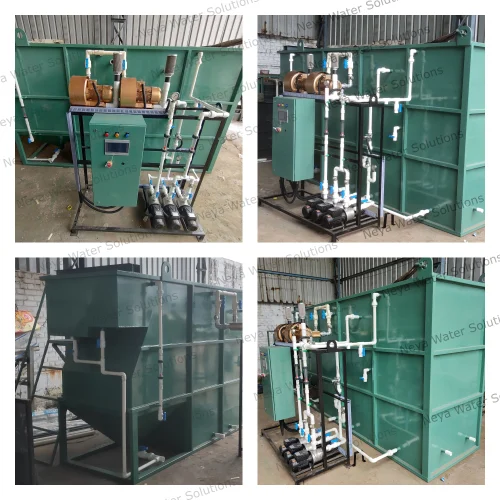
We have garnered substantial recognition through the development of highly sought-after Waste Water Treatment Plants. Our expertise lies in crafting these plants from a range of materials, all while ensuring that efficiency standards are upheld.
Wastewater treatment plants play an indispensable role in modern society by safeguarding the public from pollutants present in sewage and effluents originating from industrial processes. Among the widely adopted wastewater treatment methods, biological treatment utilizing bacteria for the breakdown of organic waste prevails. Once properly treated, the wastewater is fit for responsible environmental reuse.
A typical wastewater treatment plant generally encompasses primary, secondary, and at times, tertiary treatment stages. For instance, in most municipal sewage treatment facilities, primary treatment involves sedimentation tanks, while secondary treatment involves microbiological decomposition. Further stages may incorporate microfiltration, ultrafiltration, or nanofiltration to eliminate micro-organic particles, ion exchange to address hardness or heavy metal ions, and activated carbon treatment to handle organic molecules.
The wastewater treatment process occurs through several stages. In the initial stage, water circulates in a settling tank to facilitate the settling of particles. The subsequent stage takes place in an aeration tank, where oxygen levels are controlled, and microorganisms break down the sewage. The final stage unfolds in a clarifier, where any remaining solid waste settles at the bottom and can be removed. The effectiveness of this process is evident as it has been employed for over 2,000 years.
We extend our services to various sectors:
Residential Colonies and Apartments
Schools, Hostels, and Colleges
Hospitals
Hotels, Resorts, Restaurants, and Malls
Industrial Units
Other Institutional and Community Buildings, including large temples
Temporary Installations for Military and Paramilitary Forces.
We have garnered substantial recognition through the development of highly sought-after Waste Water Treatment Plants. Our expertise lies in crafting these plants from a range of materials, all while ensuring that efficiency standards are upheld.
Wastewater treatment plants play an indispensable role in modern society by safeguarding the public from pollutants present in sewage and effluents originating from industrial processes. Among the widely adopted wastewater treatment methods, biological treatment utilizing bacteria for the breakdown of organic waste prevails. Once properly treated, the wastewater is fit for responsible environmental reuse.
A typical wastewater treatment plant generally encompasses primary, secondary, and at times, tertiary treatment stages. For instance, in most municipal sewage treatment facilities, primary treatment involves sedimentation tanks, while secondary treatment involves microbiological decomposition. Further stages may incorporate microfiltration, ultrafiltration, or nanofiltration to eliminate micro-organic particles, ion exchange to address hardness or heavy metal ions, and activated carbon treatment to handle organic molecules.
The wastewater treatment process occurs through several stages. In the initial stage, water circulates in a settling tank to facilitate the settling of particles. The subsequent stage takes place in an aeration tank, where oxygen levels are controlled, and microorganisms break down the sewage. The final stage unfolds in a clarifier, where any remaining solid waste settles at the bottom and can be removed. The effectiveness of this process is evident as it has been employed for over 2,000 years.
We extend our services to various sectors:
Residential Colonies and Apartments
Schools, Hostels, and Colleges
Hospitals
Hotels, Resorts, Restaurants, and Malls
Industrial Units
Other Institutional and Community Buildings, including large temples
Temporary Installations for Military and Paramilitary Forces.
00 Reviews
5 Star
0
4 Star
0
3 Star
0
2 Star
0
1 Star
0
No reviews yet. Be the first to review this product.
Using recycled water can contribute to saving the Earth by conserving freshwater resources, reducing pollution, and promoting sustainable water management practices. Here's how:
Conservation of Freshwater Resources: Freshwater is a finite and essential resource. By using recycled water for non-potable purposes like irrigation, industrial processes, and toilet flushing, we reduce the demand for freshwater from traditional sources such as rivers, lakes, and groundwater. This conserves these resources for essential uses like drinking water and ecological support.
Mitigation of Water Scarcity: Water scarcity is a growing global concern due to population growth and climate change. Recycling water helps mitigate this issue by creating an alternative, reliable water source during times of drought and scarcity.
Reduction of Pollution: By treating wastewater and reusing it, we prevent the discharge of pollutants into natural water bodies. This helps maintain water quality, protect aquatic ecosystems, and reduce the impact on aquatic life and human health.
🔒
Full Sustainability Report
Unlock the complete AI-powered lifecycle analysis — certifications, verdict, carbon comparison & more.